

- A hospital strategic plan can help the board answer one central question: where is the organization going, and how will the board know it is getting there?
- Often, the board sets direction through a few clear pillars, and management has room to decide how to carry them out.
- A plan can stay simple: a small set of pillars, plus a few measurable results each year that show whether the organization is moving.
- A plan tends to earn its keep after adoption, when the board reviews progress on a regular schedule.
- If your board hasn’t opened the plan in six months, it may be a document more than a strategy.
What Is Strategic Planning in Healthcare?
Strategic planning in healthcare is a process a hospital or health system can use to decide where it is headed, often over the next three to five years, and what to focus on first to get there.
A strategic plan is generally separate from the budget and the annual operating plan. Those describe what the organization expects to do this year. A strategic plan tends to describe what the organization is trying to become, and which few priorities may matter most on the way.
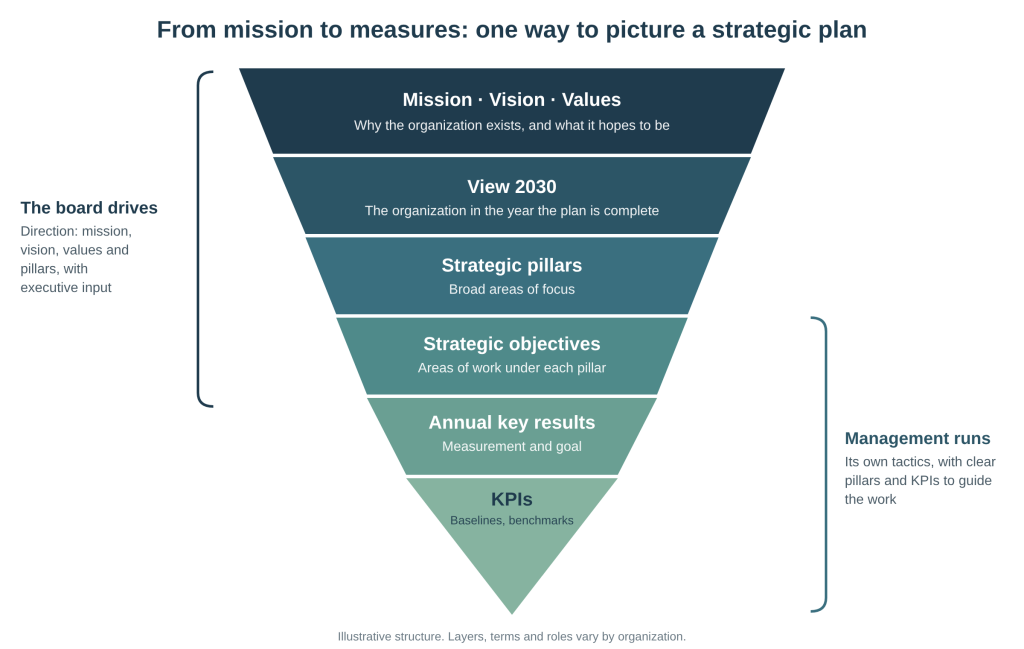
Plans take different forms, and terms vary from one organization to the next. This is one way to think about the building blocks, and an organization can adapt, combine or leave out layers to fit its needs:
- Mission: an enduring statement of the organization’s purpose, the reason it exists.
- Vision: a memorable, aspirational picture of what the organization hopes to be, often written to last across planning cycles.
- Values: the behavioral guidelines for everyone in the organization.
- View 2030 (or another target year): a word picture of the organization in the year the plan is complete, assuming very successful implementation.
- Strategic pillars: the broad areas of focus that, taken together, can carry the organization toward the view. Many plans group pillars into categories. Alignment tends to be stronger when the board owns the pillars and they connect directly to the work management carries forward.
- Strategic objectives: more specific areas of work under each pillar, often two or three per pillar. They are typically not dated or measured.
- Annual objectives and key results: the few areas the board may choose to improve in the year ahead, each pairing an objective with key results. Each key result includes a measurement and a goal.
- Key performance indicators (KPIs): the broader set of measures tracked regularly to monitor organizational health, usually compared with baselines and benchmarks rather than goals.
In this view, each layer can be traced back to the one above it, from the organization’s mission and vision down to what is measurable.
Why Does Strategic Planning Matter for Hospitals and Health Systems?
A plan matters because it gives the board a way to judge management’s results against something the board agreed to in advance. Here is what else a plan can do.
Clear vision and direction
Board members, executives and frontline staff can work from the same picture of where the organization is going. A time-bound statement like “View 2030” makes that picture concrete, because every proposed pillar and objective can be tested against it.
Better decisions about where to invest
Money, staff and capital are limited. A plan built on financial, service line, quality and market data can show where the organization is strong and where it is exposed. That can give the board a basis for deciding what to fund first, and what not to fund at all.
Stakeholder ownership
People who helped shape a plan tend to understand the reasoning behind it, so they are often more likely to stand behind it when decisions get hard. Their input can also tell the board what physicians and the community expect.

The ability to adapt as conditions change
A plan often draws on a scan of regulatory and reimbursement changes, competitors and demographic trends. Clear pillars leave management room to adjust tactics when a new payer policy or a competitor’s move arrives, without reopening the whole plan. A plan that sits on a shelf can’t do that.
Measurable results and accountability
Annual key results, each with a measurement and a goal, turn direction into something the board can check. Reporting on them, alongside a broader set of KPIs, shows whether the organization is moving toward the pillars the board set.
What Does a Hospital Strategic Plan Look Like?
Plans take different forms, and many are short. One page can hold the mission, vision, values and View 2030 statement, with a page for each pillar that lists its strategic objectives.
Here is how pillars, objectives and results can fit together in a sample plan. The numbers are for illustration only.
Pillar
Example Strategic Objective
Example Key Result
and Goal
Prepare for Growth
Strengthen the hospital’s reputation in its communities
Public perception and awareness of the hospital: up 5 percentile points
Create an Engaged Culture
Build leadership capacity and keep strong staff
Employee engagement composite score: up 2 percentile points over the prior year
Pursue excellence
Deliver safe, high-quality care
CMS Hospital Compare clinical quality indicators: 90th percentile
Achieve financial stability
Sustain the margin that funds the mission
Operating margin: 3.75%
One way to picture the structure is an upside-down pyramid. The mission, vision and values sit at the wide top and drive down into the pillars, strategic objectives and results at the narrow point. With the board driving from the top, clear pillars leave management free to run with its own tactics and track clear KPIs. The number of pillars and the level of detail vary by organization.
What Is the Board's Role in Strategic Planning?
Roles vary by organization, but one common division works like this. The board sets direction: the mission, vision, values, View 2030 and strategic pillars, with input from executive leadership. The strategic objectives under each pillar are developed in partnership with executive leadership.
Each year, executive leadership proposes the objectives and key results, and the board approves them. Leadership also tracks the broader set of KPIs and reports on them to the board each quarter.
Board-led planning is one way to put that role into practice. This short video explains the approach.
A lot of organizations are taking another look at their strategic planning efforts, dusting off the old strategic plans and, in many cases, updating them. One of the things I really enjoy about the strategic planning approach we use at Via Healthcare Consulting is that we think of it as a change management effort. We’re always focused on the end result we’re looking for out of this process, and that means the people who will ultimately be asked to help carry out the strategic plan are involved in creating it.
The other piece that is a little different about how we approach strategic planning is that we believe it has to involve the board at a very real and fundamental level. We call it board-led strategic planning, but don’t get nervous. That doesn’t mean we turn it over to the board members and expect them to be experts on the strategies the business should employ. It means board members participate and get educated along the way, so that when the plan is done and adopted, it’s something they can sink their teeth into. They understand it, and they can use it on an ongoing basis.
There’s a lot of power in involving the board, the management team, the medical staff and clinical providers in setting your strategic direction. The strategic planning projects we’ve been involved in that are the most successful are the ones that really think about change management, and about what we want to attract people to do differently going forward, so that the organization can succeed and thrive in these really challenging times.
What Are the Steps in the Hospital Strategic Planning Process?
One way to organize the process is a five-step road map. Steps, timing and sequence can look different from one organization to the next. Each step below ends with the board’s part.
Step 1: Plan and prepare
Start with who, where, when and what. A strategic planning task force confirms the process and the project’s objectives, empowering the group to plan a strategic planning retreat.
The board’s part: appoint the task force and say what the plan has to answer.
Step 2: Collect, analyze and synthesize data and information
Gather what the board needs to make good decisions before anyone sits down at a retreat. Many organizations look at three to five years of trend data, plus what the people the plan will affect have to say, gathered through interviews, focus groups and surveys. Then summarize the findings in an environmental scan. The scan often draws on areas such as these:
- Stakeholder input: board members, key medical staff and administrators, and community leaders where appropriate
- Organizational performance: how the organization has performed over the last three to five years, including areas such as financial results, operations, quality performance, service lines, and physician engagement and recruitment
- Market trends: what is happening in healthcare nationally, regionally and locally
- Competitors: the competitive landscape
- Demographics: a clear picture of the population and community you serve
- Partnerships: existing and potential partnerships that advance the mission and vision
The board’s part: help identify the stakeholders to contact for input, and read the environmental scan (the data) before the retreat. Consider sending a few “thought questions” ahead of time so members can think them through as homework.
Step 3: Convene and make decisions
The strategic planning retreat is where the board can confirm key assumptions, the mission, the vision and the values, and agree on the critical strategic issues. An outside facilitator can help. Document every decision, direction and action item.
The board’s part: make the decisions.
Step 4: Report and refine
Pull the retreat’s decisions, directions and action items into a draft plan. Senior leadership develops the first year’s objectives and key results, and the draft goes back to the board, medical staff, administrators and community leaders for input. Make edits as needed.
The board’s part: test whether the draft reflects what it decided.
Step 5: Agree and formalize
The board approves the final plan at a meeting and puts it on the record. Then management builds the detailed implementation plan, with an accountable leader, a due date and the resources needed for each piece of work.
The board’s part: adopt the plan and put its review on the calendar.
One common sequence has the board review the draft framework in a closed session, review the draft plan in an open session and adopt the final plan in an open session. Check your state’s open meetings requirements for which sessions must be public.
What Questions Should Board Members Ask About the Plan?
Whether a plan is new or three years old, these questions can show how strong it is:
- Is every key result measurable? If a result says “improve” or “be great,” it isn’t measurable yet.
- Who is accountable for each key result? One name, not a committee.
- What is the plan based on? Look for multi-year trend data, not one good quarter

- Who was heard from? Board members, medical staff, administrators and community leaders are usually part of the record.
- What is the organization choosing not to do? A plan with no trade-offs can read like a wish list.
- When is the next review? If the answer is “we’ll see,” put a date on the calendar.
What Should a Board Do If the CEO Leaves During Strategic Planning?
Consider a scenario often used in board discussions. A hospital district board has spent nine months developing a plan with its medical staff and community when the CEO announces plans to retire at year end. (The scenario is a fictionalized composite.)
The board has real choices to weigh:
- Adopt the plan, because the work reflects the community’s needs and the board’s own direction
- Pause until the new CEO is chosen, so the person who must carry it out helps shape it
- Adopt it and schedule a review once the new CEO is in place
Whichever path it takes, the board can decide deliberately, share the plan with CEO candidates and ask each candidate how they would approach strategic direction. Succession and strategy are connected decisions.
How Often Should a Hospital Update Its Strategic Plan?
Many boards review progress on a regular schedule, such as quarterly, with the annual objectives and key results refreshed each year. The pillars and strategic objectives tend to hold steady across the plan’s years, though they can be revised, added to or retired as circumstances change.
A plan may need an earlier update when something material changes, such as a merger or affiliation decision, a leadership change or a major shift in reimbursement.
What Should Your Board Do This Quarter?
You don’t need to start a full planning cycle to get more out of the plan. Three places to consider starting:
- Find your plan. Check when it was adopted and when the board last discussed it.
- Test the plan. Ask the questions in the section above, such as whether each key result is measurable, who is accountable for it, who was heard from and when the next review is. Where the answers are unclear, consider adding a measure and a named owner, and revisit any pillar or objective the organization isn’t resourcing.
- Put it on the calendar. Schedule a review of key results and KPIs at regular board meetings or quarterly.
Making the case for a retreat. Deep strategic work can be hard to do between everyday agenda items. A retreat takes the board away from the noise of daily operations and gives it room for the thinking that planning requires. If members need convincing, read how to get board buy-in to hold a strategic planning retreat.
If your board is starting a new plan or refreshing an old one, outside help can speed things up. Learn how a healthcare strategic planning consultant works with boards. Throughout her nearly 30-year career, Karma Bass has been a sought-after speaker, facilitator, and consultant with in-depth knowledge and experience in governance, strategic planning, philanthropy, quality oversight, healthcare policy, and board effectiveness. Book a free consultation with governance expert Karma H. Bass, MPH, FACHE, CEO and Managing Principal.